Thursday, May 28, 2009

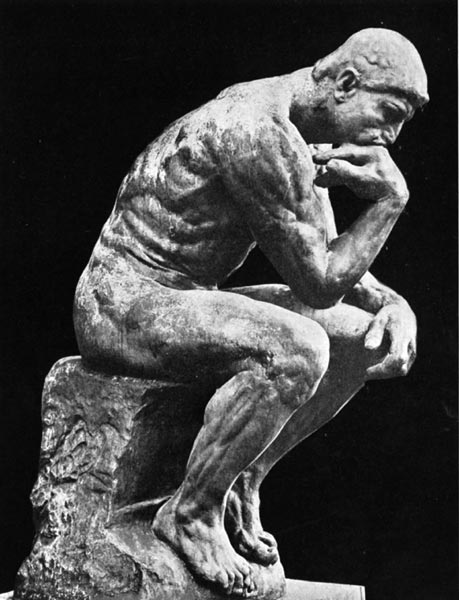
I Feel Therefore I Am


"So...... how does that make you feel?" How many times have you heard that question? There seems to be a lot of stock being put into how we feel about well... everything. Today's individual is very concerned about how things make him or her feel. We tend to measure whether something is good or bad based on how it makes us feel. There is a whole branch of psychology devoted to studying our moods. Today's marketing targets us at our most basic level--our senses or how their product will make us feel. Even universities create classes that are conducive to how they make their students feel.

So where does this come from? Well, there are many possible factors but we can usually trace these kinds of phenomena to some philosophy. Jean-Jacques Rousseau was a French philosopher and nationalist who helped to inspire both the French and American revolutions. He didn't care much for civilized man but rather thought that a life of simplicity brought greater happiness. He was a hedonist of sorts because he sought pleasure through the senses. Hedonism is one of the oldest philosophies and has had hundreds of forms over the millennia. To feel was to be alive. I can't think of a more precise description of today's world. It is feeling--not thinking--which is the highest good. When facing a decision, most people ask themselves "how will this make me feel?" If good, then it is a good decision. If bad, then then it must be a poor choice. Think about your last decision. What was it based on? This kind of choosing seems rather harmless but when applied to world of ethics, it is extremely flammable.

We see this in our everyday lives: whether or not we drink water or cola; whether or not we go to class or hang out with friends; whether or not we wear jeans to the party or go with shorts. We are constantly making little seemingly insignificant choices all day long. But what is driving these choices? Well, if you are not aware of these choices, chances are they are purely based on feeling. There is much good in understanding and expressing our feelings about things. It is human at the core. But when we make decisions solely based on what make us feel good, we get ourselves in big trouble.

There was a recent movie that came out a few years ago called Equilibrium about a future Matrix-like world in which emotion has been eradicated from humans because they were blamed for being the cause of war. So this "peaceful" society now exists led by a big brother type government. A rebel group of "feelers" is committed to preserving emotion as an essential aspect of humanity and they are willing to die for their cause. I whole-heartedly agree with the premise that emotions are both a necessary and good part of the human condition. But are they the sole lens by which we should see the world? Raw emotion without the restraints of thinking often leads to outbursts of anger, harsh words spoken, neglect, infidelity, murder and many other damaging effects to human relationships.

But stoicism and the bottling up of emotions are hardly the answer. So what should we do with our feelings? Isn't "following your heart" always the highest good? Aren't we to treat ourselves with love first so that we may love others? Tell that to the husband of an unfaithful wife or the child who longs for the attention of her materialist-driven parents. Sometimes the perceived highest good is actually the worst possible evil. Selflessness and not selfishness, contrary to popular belief, is the key to happiness. And we could not "know" that truth by feeling alone. I think the words of Christ are very instructive for us in regard to this topic.

And He was saying, "That which proceeds out of the man, that is what defiles the man. For from within, out of the heart of men, proceed the evil thoughts, fornications, thefts, murders, adulteries, deeds of coveting and wickedness, as well as deceit, sensuality, envy, slander, pride and foolishness. All these evil things proceed from within and defile the man." Mark 7:20-23

It is leading with our feelings and inner desires which will get us in trouble, but if we renew our minds every day by the power of the Spirit of God, our good deeds will soon follow.

...assuming that you have heard about him and were taught in him, as the truth is in Jesus, 22 to put off your old self, [5] which belongs to your former manner of life and is corrupt through deceitful desires, 23 and to be renewed in the spirit of your minds, 24 and to put on the new self, created after the likeness of God in true righteousness and holiness. Ephesians 4:20-24

Our true spirit is in our mind. God changes what we think before He addresses our feelings about a particular thing. This is not to say that we don't feel--on the contrary--we are feelers to the core, but what we feel should be based on the beliefs we have in our heads. And unless the hard wiring is changed out we will always be led by the faulty sparks that are jumping around at random and at the gut level. Humanity is not merely emotional, merely physical, merely rational, or merely spiritual but is all of the above and although they can be distinct they can never be separated. So not only should we be "feelers," we should be thinkers first.

Thursday, May 14, 2009

Does God go to Church?


Church. What image immediately comes to your mind? Probably something like a cathedral or a building with a steeple or priests and altars. For some maybe a singing worship songs and hearing a sermon is what comes into mind. Does that sound exciting? For many that is true but probably for many more--not so much. If we aren't that excited about church, did you ever think that God might not be that excited either? That sounds weird. I mean God and church go together like PB & J. Right? For what possible reason would God not go to church? I think this is the right question. But far too often we ask, "For what possible reason do I have to go to church?" And sadly, the church itself has chosen to answer the latter instead of the former. This kind of thinking is endemic in the American church.

So why would God not want to show up at church? Well, believe it or not there have been times on record when this has occurred. Back in the Old Testament times the nation of Israel, who were supposed to be God's people, had forsaken their God to go after other gods. However, they still went to church. They still gathered every Sabbath and paid God lip service. Their leaders did not obey God's commands for worship. So God refused their sacrifices:

" 'Oh, that one of you would shut the temple doors, so that you would not light useless fires on my altar! I am not pleased with you,' says the LORD Almighty, 'and I will accept no offering from your hands.'" Malachi 1:10


Wow. God would rather the doors of the church be closed than for people to come and only pay lip service to Him. In another instance God says this:

"My people come to you, as they usually do, and sit before you to listen to your words, but they do not put them into practice. With their mouths they express devotion, but their hearts are greedy for unjust gain. Indeed, to them you are nothing more than one who sings love songs with a beautiful voice and plays an instrument well, for they hear your words but do not put them into practice."

Ezekiel 33:31-32

So what is God saying? Are there times when God will not go to church? Absolutely. I think we forget that God is a person--the greatest person. Everything we admire in others is only a shadow of the person of God. He is the most admirable, most kind, most caring, most honorable, most truthful, most just, most infinitely loving person to ever exist. And as such, He desires that we as his creatures, reflect who He is. And when we make church about us, we not only do a disservice to the honor and glory of God, but also a disservice to our own happiness. When we make church about what songs we like to sing and sermons we like to hear, then boredom is the best possible outcome and hypocrisy and idolatry at worst. If church is boring, then perhaps it is because the God of our own choosing is just that. Let's worship the True God, whom boredom can never be attributed.

Tuesday, April 28, 2009

Freedom: Illusion or Reality?


Free will is one of those topics with endless discussion (hence this article), but not without good reason. It is a fascinating and pervading subject that touches us where we live. Do we really make "free" choices? Or are things "predetermined" for us and the entire universe. These are big questions that challenge everything--which is why my mind seems to constantly run back to it. There are no doubt many many features to this debate which cover anything from whom we will marry to whether or not subatomic particles acting randomly are the cause of the universe. I am "choosing" to talk about things relating to the first kind; everyday life.

It has been asked, "Can I determine the course of my life?" This is something I think most of us have entertained at some point whether earnestly or just for fun. I recently encountered the "free-will" discussion a couple of times last week. One of my students is working on a paper for his English class in which he is discussing free will vs. fate in the lives of Romeo and Juliet. Did they truly defy their circumstances however bleak or did they foolishly and inevitably fall into the hands of fate? One thing to be asked in this controversy is whether it is even possible to know the answer. Differing perspectives adequately explain both sides.... or at least it seems to be so.

Question. Did you choose to read this article or were you compelled by forces outside of yourself? Are there preconditions that led you to this inescapable point? On the other hand, what reasons are there to assume that there is anything other than your own will? Do you not go where you want to go? Are you not the "captain of your own ship?" Can you ever remember a time where you did something in complete opposition to your own inclinations? If everything is predetermined, how would you act as if you were in accordance with it. And if you chose "the road less traveled," is it always "with a sigh?"

All these questions skim the surface of a more deeper reality: If there is some kind of outside force that bends everything ultimately to its "will" what then is it? Nature? The Universe itself? God? First we must answer the question as to whether or not we can truly make "free" choices.

Suppose you are deciding whom you should marry. I like to awkwardly ask my single friends "Do you think you already know your future spouse or do you think you have yet to meet them?" Whether they reveal their true answer or not remains to be certain but their immediate repulsion or excitement at the question is a pretty good tell in my opinion. Now suppose this questionee was trying to decide between two good choices (3, 4 or 5 for some). Person A is very good-looking, very promising and shares the same set of beliefs. Person B is also very good-looking, promising, and shares the same core values and beliefs. The only real difference is that one is a redhead and the other a brunette (Blondes have been left out of this discussion to protect the innocent). So is their truly a "better choice?" Well, if one believes in preordination there might be some anxiety involved in this choice. Will I choose the right person? Conversely, there might be anxiety on the part of someone who believes that their life is completely what you make of it. There is an anxiety of an uncertain future.

I'm not sure I can adequately answer this question of which perspective is indeed true from a human perspective-- in fact I'm certain I cannot. But being human, I realize that my questions require an explanation that transcends simple reason. In the case of redhead vs. brunette I think both perspectives struggle with shaky reasons. The only way I can sufficiently be sure I am making the best decision is if my reasons--whether "free-will" or "predetermined"--are trustworthy. It comes down to whether or not I am a trustworthy decision-maker or if the outside force is. One thing I know for myself is that I often make very bad choices. So for me, the issue is what outside force will I trust and depend on. Scientific realities are not really helpful aside from racial, medical and genetic factors. I mean I think scientists make as many bad decisions about whom to marry as non-scientists do (if you disagree please show me how this is not the case). So in terms of life decisions, the better question to ask than "are my choices free," is "Am I a sufficient and sound decision-maker?" This is a question I cannot answer for you. I only admit that I am not. And as most of you know, I "choose" to rely on the wisdom of Jesus Christ, King of kings. He is not only a good decision-maker, He has proven to be the best and most wise decision-maker in my life. What or who is yours?

So what about Romeo and Juliet and is it the redhead or the brunette? Well, they trusted their own inclinations and perhaps it was not a mysterious fate that was the cause of their demise, but simply a lack of wisdom. And as for the redhead or the brunette, in my case I have chosen the better.. but I don't think it had anything to do with follicles.

Tuesday, March 10, 2009

Are we Postmodern?

Remember when you were a kid and you asked your Dad or Mom, "Are we rich or poor?" I wish I still had that same innocence--some would say "ignorance"--of reality. Perhaps, we were closer to reality when we didn't have our negative filters on; when we didn't know "better." In much the same way, most of us don't know what being postmodern means, much less whether of not we are postmodern. Maybe we're modern? "So Dad, Are we 'modern' or 'post-modern'?" "Well, son. It's a generational thing. Your grandfather is post-mortem." Wow. That's a really bad joke. Sorry. I couldn't help myself.

Postmodernism is simply the state of being after the modern era. So what's the modern era? These are philosophical definitions of the most recent time periods in history. The modern era is usually defined as the period which sprung from the 17th century Enlightenment period, which in turn, sparked the modern science movement. Are you back in 9th grade history yet? The "modern" era is simply the age when an empirical approach to knowledge emerged. This means that the way we "knew" things was primarily done by verification or experimentation, such as using the scientific method. So let me ask you a question. Do you believe that this is the way we should measure whether something is true or not? Most of us would tend to say "yes." At least when it comes to "science." But why then do we have a different approach to our philosophy of life? If we are consistent, we would also judge our belief systems this way. But we tend to say, "Well, what's good for you is good for you and what's good for me is good for me." We don't hear scientists speak this way about their research.

So why don't we take this approach to the world of science? After all, we have to be fair-minded, right? Why don't we have a care-free attitude toward scientific studies or even scientific truths? I don't really know anyone who has a care-free attitude toward the law of gravity. "Hey man, don't get on me with your gravity kick." This is because even though many don't like the label of being a "modern" the reality is that we are still very much "modern-like." And that is because being rational is not in itself a bad thing--it's a good thing. But being a rationalist is entirely different. That's taking reason and cause and effect to a level it was never intended for.

A postmodern view of knowledge is one that challenges all previous thought. But how is this any different than any human era in history? Well, the postmodern mind cares more about things relating to one another and not so much how or why--that's for the non-relational people. But this kind of thinking can be equally as dangerous as its opposite. There is an underlying arrogance to it. While it seems humble, it undermines all previous thought and judges it too certain. And they are certain about that. We see this all the time. It's your university professor preaching tolerance of all worldviews except any view which claims to be certain of anything. It's your neighborhood pastor telling you God loves you but is not sure if He exists. Its deciding never to marry because it is a commitment based on predicting the future, which is totally uncertain. These are signs of postmodern thought. On the surface is very noble, but underneath is founded upon skepticism.

As a Christian, my goal is neither to be "modern" or "postmodern" or any other classification of historical thought. Rather I want to transcend my surroundings and live by the Truth which never changes--God's Word.

"Do not conform any longer to the pattern of this world, but be transformed by the renewing of your mind. Then you will be able to test and approve (this also means prove) what God's will is--his good, pleasing and perfect will." Romans 12:2

This is my goal in this life. I want to live free from uncertainty and doubt. I do not want to doubt whether or not I love my wife and I don't think she wants me to either. I want her to know that I love her and she can be sure of it. And the only basis for this kind of certainty is if I am living by eternal truths given by One who is infinitely wise. So as I do, I am proving to my wife that God's will is good and she can know without a doubt that I love her with all my heart. This is how I want to love this world, even if it is not sure about me.

There are many things of which we can never be certain, but there is one thing of which we must be certain:

He who has the Son has the life; he who does not have the Son of God does not have the life. These things I have written to you who believe in the name of the Son of God, so that you may know that you have eternal life.

1 John 5:12-13

I want everyone to have this kind of certainty.

Saturday, March 7, 2009

Economics 101: Back to the Basics

The Free Market. What does this mean? Free money? Well, I don't think anyone truly believes that but what exactly is meant when people talk about the "market" as if it were a roller coaster at Magic Mountain? It goes up, up, up. And then down, down, down. It takes you for a turn and then shakes you upside down. Then somehow seems to always drop you exactly at the same place you started. And then why do we get in line again? What is this madness? The thrill of the market. Except this time around we seem to have gotten stuck on the ride and we're waiting for the repair man to "bail" us out.

A very famous man once predicted the future of the "free market":

1. Capitalism will move into a period of overproduction.
2. Wages will be reduced.
3. The worker's purchasing power will be reduced.
4. A surplus of goods will be created.
5. A war will be started to use up the surplus.
6. Postwar stress will end in the system's self-destruction.

Wow. This is frighteningly close to our situation. Today's financial world is run by large corporations, a.k.a. oligarchies, which is the older term for the same thing. The man who predicted this was born almost 200 years ago: The philosopher/social reformer Karl Marx. The above quote is taken from R.C. Sproul's The Consequences of Ideas if you want a further reading of Mr. Marx and friends. It seems as though Marx was right (at least to some degree) but he was just 150 years off or so. So what am I saying? Am I a socialist? Certainly not but that is the immediate response of many who hold strongly to today's capitalism. It is the red trump card they hold in their hand when anyone attempts to point out the faults of the free market economy. Newsflash. McCarthyism has not completely died out. Unfortunately, today's Christian has been caught in the cross-hairs because to be Christian is to be a capitalist--at least this is what American Christianity has come to mean for many. But is this right? Does God believe in free trade? This is a tricky question and I am not writing to defend Marxism nor Capitalism. No. I want to be a Biblical thinker. Let's use the wisdom that God gave us--His Word--not to mention our ability to reason. Wisdom is the ability to properly apply reason from what God has already revealed as true.

Thomas Aquinas was a smart guy. He laid down some pretty heavy stuff in his pivotal work the Summa Theologica. In it, he gives some very good guidelines for the proper use of money and lending. In response to the question "Whether it is a sin to take usury for money lent?" he states:

I answer that, To take usury for money lent is unjust in itself, because this is to sell what does not exist, and this evidently leads to inequality which is contrary to justice...

Accordingly if a man wanted to sell wine separately from the use of the wine, he would be selling the same thing twice, or he would be selling what does not exist, wherefore he would evidently commit a sin of injustice. In like manner he commits an injustice who lends wine or wheat, and asks for double payment, viz. one, the return of the thing in equal measure, the other, the price of the use, which is called usury...

Now money, according to the Philosopher (Ethic. v, 5; Polit. i, 3) was invented chiefly for the purpose of exchange: and consequently the proper and principal use of money is its consumption or alienation whereby it is sunk in exchange. Hence it is by its very nature unlawful to take payment for the use of money lent, which payment is known as usury: and just as a man is bound to restore other ill-gotten goods, so is he bound to restore the money which he has taken in usury.
Summa Theologica: Treatise on the Cardinal Virtues (QQ[47]-170): Question 78


Simply put, it is wrong to profit from lending money which doesn't exist. He argues earlier that a silver vessel has intrinsic value and can be sold or rented out lawfully for use, but the aquiring of money by using money that does not represent anything real is illegitimate. Wow! That's heavy stuff! Again, I am not trying to prove or disprove the validity of capitalism but merely to properly apply it. Certainly, had we listened to Aquinas our nation would not be in the current bind it is in.

Well, that's what some Philosopher thought in his ivory tower centuries ago. "Why should I listen to him?" you might say. Well, there is yet one more principal from a much higher source of ethical writings:

"If you lend money to My people, to the poor among you, you are not to act as a creditor to him; you shall not charge him interest." Exodus 22:25

In the Hebrew context, what is meant by "creditor" is one who seeks to extort for selfish gain. We are not to take advantage of those who are in need. And yet this has become a cornerstone of American capitalism. It is usury in the worst sense. What must also be noted in this verse is that interest, in itself is not a sin, but excessive interest, specifically to those who are without the ability to pay it back.

One of the eye-opening realities I learned in my macroeconomics class at Cal State LA (go Golden Eagles!--the diablos for some of you older folk) was the crooked way in which banks "make" money. If an account is opened for $100, and a pretty low reserve amount of let's say $20 is kept, that same $100 is lent out maybe 5, 6, even 10 times over--magically creating capital out of thin air! This is astounding. It is no wonder that we have no more money--it never really existed. I know that I am over-simplifying many complex ideas and concepts about the free market system but I am attempting to speak on the level. The economists, lawyers, politicians, bankers and large corporations who have not upheld these Biblical principles are the ones who got us into this mess. So forgive me if I am a bit skeptical of their solutions.

It is time to get back to the basics. Who says the Bible is antiquated and too "out-dated" to suit the complexity of today's market? Well, it seems those in this camp are the same ones who need it the most.

Thursday, March 5, 2009

An Open Letter to the President

Dear Mr. President,

I am exceedingly glad that you have been made our 44th president of these United States despite the racism that has plagued our country for hundreds of years. However, I am concerned that you may be the victim of mistaken identity. It seems that there are many who would, without a moment’s notice, lay their life down for you. This kind of great loyalty is to be commended and has frankly been absent from within our borders for quite some time. It has indeed been a long time since we have had such a leader with such strength, humility, and outspokenness against the injustices of our time. “Hope” is your badge and “change” is your right arm. You are loved by many and have the devotion of millions. You are seen as the one who will restore justice inside our borders and peace from without. You have promised us a bright future and put many at ease with your candor and great smile. You speak as one with great authority and yet whisper gently into your children’s ears. Your voice is heard as the marriage of grace and truth.

Mr. President this concerns me. Why? Because you are a man. There has only been one man in all of history who truly fits the above description. He is the man Jesus Christ. You at best can offer political peace and things which perish with the using. But He offers peace with the Father who is in heaven and a life that is eternal. His kingdom has no borders and His justice knows no end. He is the fulfillment of the promise of Hope. I know you know you are not such a man. But there are many who do not. They do not even know about Him and how He came down from heaven to live the perfect life we could not live and die the death we should have died and once for all conquer death by rising again. They haven’t even heard about how while we were still yet full of hate He, being full of love, gave His life for us so that we could be free from the worries of this world and all its uncertainty. They don’t know about how in His kingdom, to be great is to be the servant of all and to serve others is to serve Him. They haven’t heard about how He is returning to take back what is rightfully His. They don’t know that you are simply a steward, a place-holder, a minion to His throne. Mr. President please tell them. They are looking to you for these things. They think you will give them that which they lack. You must not let them go on believing the lies told about yourself but rather you must give them the truth but more importantly the truth about the man Jesus.

"May all kings fall down before him, all nations serve him! For he delivers the needy when he calls, the poor and him who has no helper. He has pity on the weak and the needy, and saves the lives of the needy. From oppression and violence he redeems their life, and precious is their blood in his sight. Long may he live; may gold of Sheba be given to him! May prayer be made for him continually, and blessings invoked for him all the day! May there be abundance of grain in the land; on the tops of the mountains may it wave; may its fruit be like Lebanon; and may people blossom in the cities like the grass of the field! May his name endure forever, his fame continue as long as the sun! May people be blessed in him, all nations call him blessed! Blessed be the LORD, the God of Israel, who alone does wondrous things. Blessed be his glorious name forever; may the whole earth be filled with his glory! Amen and Amen!"

Psalm 72:11-19

Your humble subject,
Justin the lesser